
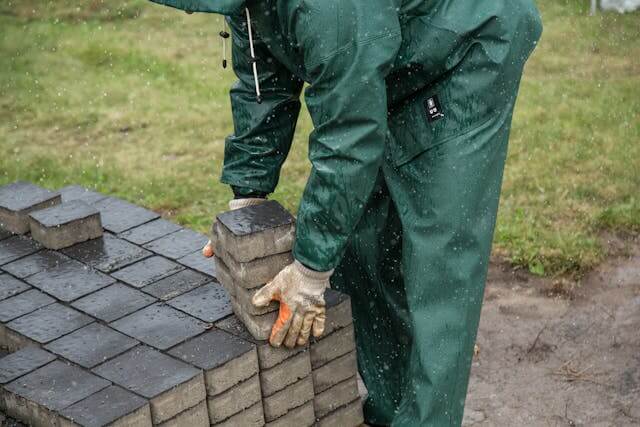


Most hardscaping call-backs trace back to decisions made before a single paver was set. Loose estimates, incorrect material quantities, or steps skipped during base prep by your crew mean you actually lose money on the project. These six best practices will not only eliminate some of the headaches that come with call-backs, but protect your profit from project introduction to final walk-through.
Conduct a Real Subsurface Assessment Before You Price Anything
Estimating the cost of building a driveway without information about what lies beneath the topsoil, such as soil composition, the proximity of utility lines, and specific elevation changes for the entire footprint is how contractors lose money before they even break ground. Invest in a site visit before submitting your estimate. If the soil is clay-heavy, you’ll need to excavate more deeply and factor in fabric to stabilize soil between the subgrade and aggregate base. But you won’t know that until you’re on the site, testing the soil.
A site visit doesn’t take long. A surprise excavation change mid-way through the project immobilizes your team for days.
Build Estimates With a Real Material Take-off Not Rough Numbers
Estimating material quantities is the first place profits are lost. To standardize the process, your materials take-off template should force you to recalculate cubic yardage for every layer, aggregate base, bedding sand, and jointing material, rather than relying on numbers you used for a previous job. Then, simply include a 10% waste buffer for pavers on every job. You’ll be amazed at how quickly cuts, breakage, and pattern adjustments eat up that buffer.
Standardize Your Screeding and Jointing Process
Screeding is mechanical. It should be done the same way on every job: damp sand, correctly spaced screed rails, a straightedge pulled across a uniform depth. Any variation in the bedding layer shows up as lippage or rocking pavers after settlement.
Jointing is where a lot of companies get sloppy. Choosing the correct grade of pavers sand for both the bedding and jointing layers is critical to preventing shifting, washouts, and expensive call-backs that show up six months after installation. Polymeric sand requires strict moisture conditions before activation. Too much moisture causes joint hazing. Too little means the binders don’t activate and the material washes out in the first rain. Train your crew on the manufacturer’s specs and don’t let them shortcut the curing window. One bad jointing job will cost you more in call-backs than you made on the project.
Treat Subbase Compaction as Non-Negotiable
The majority of hardscape failures start here. The base is not a ‘set-up’ step, it’s the layer that determines whether the surface lasts 5 years or 50. Compact aggregate lifts a maximum of 2 to 4 inches using a plate compactor. Wait until each lift has reached proper density before adding the next one. Skip that step and you’re simply allowing the pavement to settle.
Drainage slope has to be built in from the start, not added on as an afterthought. The 1% to 2% grade draining away from the foundation has to be in the aggregate layer. You can’t slap it on top.
Protect Against Scope Creep With Formal Change Orders
Scope creep can reduce profits without you even realizing it. A customer requests an additional feature, a new border design, or a larger patio. Your team makes the change without any written record of the discussion. This means you’ve just increased your labor and material expenses but you won’t be able to recoup those costs because the customer never agreed to the additional charge. That’s why any deviation from the original agreement should be accompanied by a signed change order before the work proceeds. Not doing so might impact your bottom line and your customer’s satisfaction.
It’s advisable to explain this rule before closing the deal to make sure there will be no hard feelings later on.
Close Every Project With a Formal Handover
A completed job isn’t closed until the client has signed off and received written care instructions. Walk the project with them. Let them inspect your work before you present the final bill. Document any minor cosmetic issues in writing and establish a resolution timeline if needed.
Provide a maintenance guide covering joint sand replenishment, sealing schedules, and what to avoid placing on the surface in the first 30 days. This isn’t just good service, it limits your liability and reduces the chance of a call-back caused by client misuse.
Manage supply chain logistics before the job starts too. Confirming delivery windows for bulk gravel and sand before crews mobilize is basic, but contractors who skip this end up paying idle labor costs while waiting for material.
The difference between a profitable hardscaping company and a busy one that barely breaks even usually comes down to process discipline. Lock in these six practices and the margin takes care of itself.