
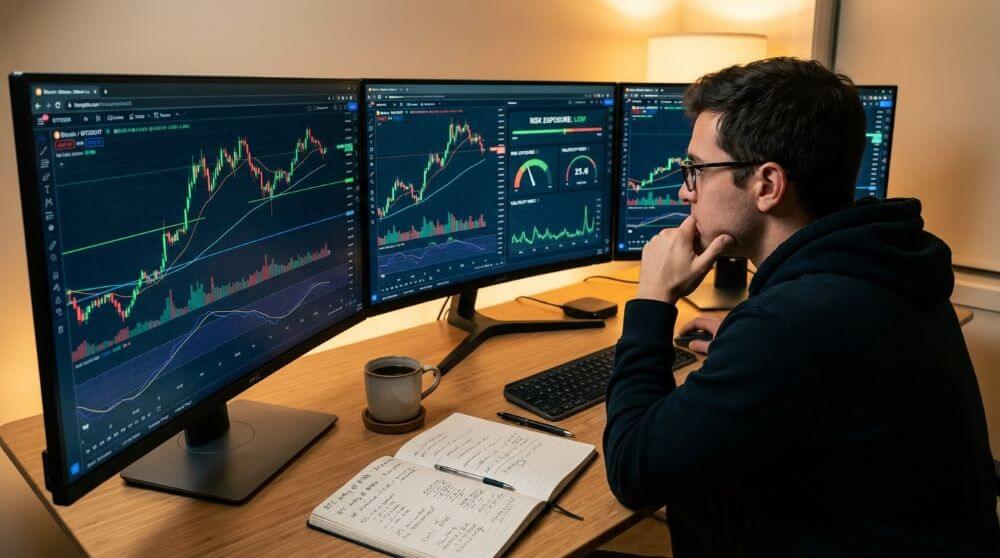


The 2026 market is moving fast, Bitcoin is holding $89k and altcoins are rotating quickly. But predicting price is only half the battle; keeping your profits is the hard part. After years of full-time trading, these are the seven non-negotiable rules I use to keep my portfolio growing steadily, regardless of market conditions.
Rule 1: The 1-2% Risk Per Trade Rule
This is the most boring rule, but it is the most important one. I never risk more than 1% to 2% of my total account on a single trade.
If you have a $10,000 account, that means the maximum amount you can lose on a trade is $200. This doesn’t mean you only buy $200 worth of crypto; it means if your stop-loss hits, your loss is capped at $200.
Why I do it:
- Survival: You can lose 10 trades in a row (it happens to the best of us) and your account will still be healthy.
- Psychology: When you know you can only lose 1%, you don’t panic when the chart turns red.
- 2026 Context: During the Q1 altcoin rally this year, this rule saved me. I took a few losses on false breakouts, but because they were small, one good win made up for all of them.
Rule 2: Always Use Stop-Loss Orders
I never enter a trade without an exit plan. In crypto, a “dip” can turn into a 40% crash while you’re sleeping.
I usually set my stop-loss based on the ATR (Average True Range) or just below a major support level. For example, if Ethereum is at $3,900 and the daily volatility is high, I give the trade some room to breathe so I don’t get stopped out by normal noise.
The Strategy:
- Don’t use round numbers: If you put your stop at exactly $4,000, you will get hunted. I’ll put mine at $3,985.
- Trailing Stops: As the price goes up, I move my stop up. If a coin pumps 20%, I want to lock in that profit if it suddenly reverses.
Rule 3: The 60-30-10 Portfolio Split
It is tempting to go “all in” on the newest shiny coin, but that is how you blow up accounts. I use a structured split to keep things balanced.
- 60% Large Caps (BTC & ETH): This is my safety net. With Bitcoin up 8% this year, it provides steady growth with lower risk.
- 30% Mid Caps (SOL, AVAX, etc.): These are established projects with working products. They move faster than Bitcoin but are safer than memecoins.
- 10% High Risk: This is my “casino” money. I use this for AI tokens or new narratives. If it goes to zero, I don’t care. If it does a 10x, great.
I rebalance this every few months. If my risky coins pump and become 20% of my portfolio, I sell the profit and buy more Bitcoin.
Rule 4: Target a 1:2 Risk-Reward Ratio
I don’t take a trade unless I can realistically make double what I am risking.
If I am risking $100 on a trade (my stop loss), I need to see a clear path to making at least $200 profit. This is pure math. If you stick to this ratio, you can be wrong on 60% of your trades and still break even or make money.
Real Example: Last month, I identified a setup on the Bitcoin USDT exchange and longed BTC at $92,000. My risk was down to $90,000, but my target was $100,000. The reward was huge compared to the risk. Even if I lost, it was a smart bet to take.
Rule 5: Dollar-Cost Averaging (DCA)
Trying to time the exact bottom of a dip is impossible. Instead of guessing, I have an automated buy set up. Every week, I buy a fixed amount of Bitcoin and Ethereum, regardless of the price.
In January 2026, we saw a 15% correction. While everyone was panicking on Twitter/X, my automatic buys were picking up cheap coins. Over time, this lowers your average entry price and removes the stress of watching charts 24/7.
Rule 6: Cold Storage is Non-Negotiable
If you have been in crypto for more than a year, you know the rule: Not your keys, not your crypto.
I keep about 85% of my portfolio on a hardware wallet (like a Ledger or Trezor). I only keep funds on an exchange if I am actively trading them that day. With the amount of hacking attempts we’ve seen in the last two years, leaving six figures on an exchange is just asking for trouble.
My setup:
- Trading stack: Hot wallet / Exchange (15%)
- Long-term hold: Cold Storage (85%)
Rule 7: Keep a Trading Journal
This is the one rule most people ignore, but it is the “secret sauce.” I keep a simple spreadsheet where I log every trade.
I write down:
- Entry and Exit price.
- The reason I took the trade.
- How I felt. (Was I FOMO-ing? Was I angry about a previous loss?)
Reviewing this at the end of the week is painful but necessary. I realized early this year that I lose money on Fridays because I try to force trades before the weekend. I stopped trading Fridays, and my P/L immediately improved.
Conclusion
Trading isn’t about getting lucky; it’s about not dying. These seven rules helped me secure a 68% return in 2025 and are guiding me through the 2026 bull market. Start with the 1-2% risk rule, and once you master that, the rest becomes much easier.
Frequently Asked Questions
What does the 1-2% rule actually mean?
It means capping your potential loss at 1-2% of your total account value per trade. If you have $10,000, you never risk losing more than $200 on a single setup.
Where should I place my stop-loss?
Place it below key support levels or use ATR indicators. If price hits it, your trade idea is invalid, exit immediately to save capital.
Why shouldn’t I just buy 100% altcoins?
Altcoins crash harder than Bitcoin. A 60-30-10 split ensures you capture altcoin gains while protecting your portfolio with BTC/ETH stability.
Is DCA really better than trying to buy the dip?
Yes. “Time in the market” beats timing the market. Automated weekly buys remove emotional stress and ensure you accumulate during dips without hesitation.