
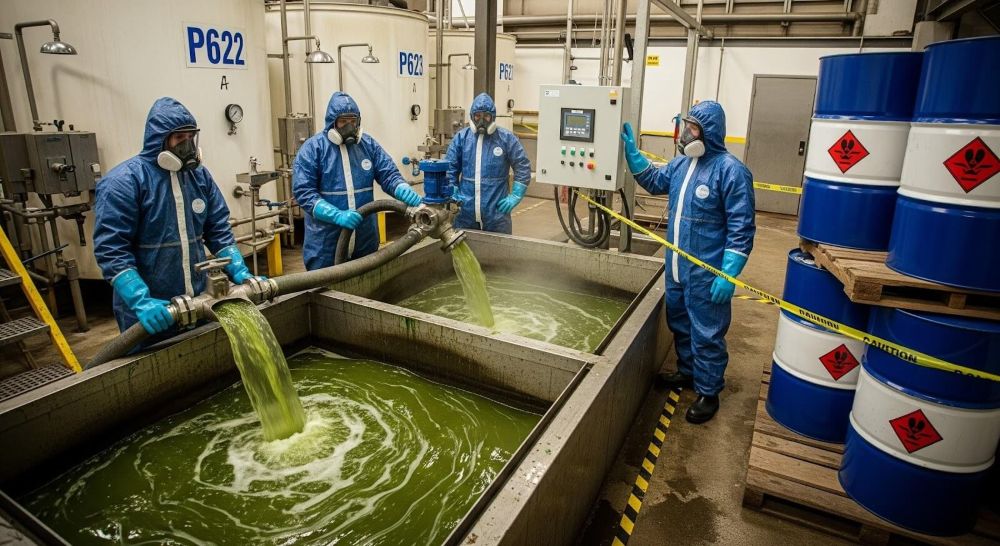


Managing hazardous waste materials is always a challenge, but this gets ramped up when the hazardous materials in question are liquid.
Liquid waste management solutions need to content with the fact that liquids can be far more challenging to contain and are prone to spilling.
The important role that hazardous waste services play becomes clear when high volumes of liquid hazardous waste are involved.
These hazardous waste disposal services make sure that the correct disposal methods are followed in line with Australian environmental regulations and so that they will not cause unnecessary harm to human health.
What defines high volume liquid hazardous waste
Liquid hazardous waste refers to liquid waste streams that contain substances requiring controlled handling and treatment due to their properties.
When these streams are produced in large volumes or continuously, they place significant demands on infrastructure, operators and treatment performance.
The hazardous removal of waste is a complex process and requires the knowledge and expertise of one of Australia’s waste management companies.
Typical hazardous waste streams in Australian industry
High volume liquid hazardous waste is commonly produced across sectors such as:
- Chemical manufacturing and formulation – think everything from pool chemicals to industrial waste
- Mining and mineral processing – including the minerals mined and the waste materials generated in the process
- Food and beverage production – this would be old food, fats and grease, and everything a kitchen might need
- Pharmaceutical and biotechnology facilities – licensed facilities have various dangerous goods on hand that cannot be thrown in generic household bins
- Metal finishing and surface treatment – not only do they have waste, but they also have a high ability for resource recovery
These hazardous waste streams often contain acids, alkalis, solvents, hydrocarbons, oils, suspended solids or high strength organic compounds.
In many cases, the composition and flow rate fluctuate throughout the day, adding complexity to treatment.
Why volume changes hazardous waste management solutions
Low volume hazardous waste can often be handled in batches or transported offsite. As volumes increase, these approaches become inefficient and disruptive.
High volume hazardous waste requires continuous (or near continuous) treatment systems that can operate reliably without constant manual intervention.
Common challenges when managing hazardous waste at scale
High volume liquid hazardous waste streams introduce a unique set of challenges that can affect operational efficiency and cost control.
Variability in hazardous waste characteristics
One of the most difficult aspects of hazardous waste management is variability.
Changes in production runs, raw materials or cleaning schedules can cause sudden shifts in pH, contaminant concentration or flow rate.
Treatment systems that are not designed for this variability can struggle to maintain stable performance, a massive issue considering that most companies producing hazardous waste don’t want it on their premises for long periods.
Space limitations and retrofit constraints
Many Australian sites operate within established footprints, so installing or upgrading hazardous waste treatment systems often requires working within tight spatial constraints without compromising safe disposal.
Compact and modular solutions are particularly valuable in these environments, particularly when they align in an environmentally friendly manner.
Maintaining production continuity
Hazardous waste systems must support production, not hinder it. Poorly performing systems can create bottlenecks, forcing production slowdowns or unplanned shutdowns.
Reliability is critical when hazardous waste volumes are high. Years of experience dictates that professionals should always be consulted.
Managing operating costs
Treating large volumes of hazardous waste can involve significant chemical, energy and maintenance costs.
Inefficient systems increase sludge production and drive up handling and disposal requirements.
A practical approach to hazardous waste management
Successfully managing high volume hazardous waste starts with a structured and realistic approach.
Hazardous waste management solutions come from some basic pragmatic principles, many of which we explore below.
Accurate hazardous waste characterisation
Understanding the hazardous waste stream is the foundation of effective treatment. This includes:
- Average and peak flow rates
- pH range and rate of change
- Types and concentrations of contaminants
- Presence of oils, solids or emulsions
- Temperature and reactivity
Accurate characterisation ensures treatment systems are designed for actual operating conditions rather than idealised assumptions which neglect specific needs in order to rush towards the final disposal point.
Segregation of hazardous waste streams
Where possible, segregating hazardous waste streams can greatly improve treatment efficiency.
So combining high strength and low strength wastes often increases chemical consumption and reduces control.
Treating compatible streams separately allows for simpler processes and more predictable performance.
Designing for flexibility and various hazardous waste disposal options
Hazardous waste volumes and compositions change over time. Note that waste treatment systems should be able to adapt without major modifications.
Modular designs allow additional capacity or process stages to be added as requirements evolve.
Planning for long term hazardous waste management
High volume hazardous waste management is an ongoing operational requirement that benefits from forward planning.
Whether they find themselves dealing with old gas bottles, industrial chemicals, or e waste, the experts always follow a plan of tailored solutions that meet Australian regulatory compliance standards.
Allowing for future growth
Production volumes and processes change over time. Designing hazardous waste systems with expansion in mind avoids costly retrofits and operational disruption later, however difficult this might be to see.
Working with experienced hazardous waste removal services
Specialists with experience in Australian hazardous waste applications understand the practical realities of operating at scale.
This experience helps translate design intent into reliable, day-to-day performance.
Most Australian hazardous waste disposal services are comfortable dealing with industrial waste, civil waste, electronic waste, and reusable materials.
Conclusion
Managing high volume liquid hazardous waste is a complex task, but it can be controlled with the right strategy.
By focusing on accurate characterisation, flexible system design and reliable treatment processes, Australian facilities can improve efficiency and operational stability.
And a well designed hazardous waste management system supports production, controls costs and delivers consistent performance over the long term.